Why Salerno Is the Best Base for Exploring Campania
Why Salerno Is the Perfect Starting Point for a More
Meaningful Journey Through Campania

When people begin planning a trip to Campania, their attention often goes first to the names they already know: the Amalfi Coast, Pompeii, Capri, Naples. These places deserve their reputation, but they can also shape an itinerary that feels rushed, fragmented, and overly centered on checklists. For travelers seeking something deeper, more elegant, and more personal, the better question is not only what to see, but where to begin.
That is where Salerno changes everything.
Set on the Tyrrhenian Sea and positioned between coast, archaeology, mountain landscapes, and lesser-known inland culture, Salerno offers one of the most balanced starting points in Southern Italy. It is a city with a real historic center, a lived-in rhythm, and direct access to some of Campania’s most important destinations. The official Italian tourism portal describes the province of Salerno as home to some of the region’s most visited destinations, while also highlighting the city’s preserved medieval structure and layered cultural identity.
For us, that is exactly what makes it powerful. Salerno is not simply a stop between places. It is a refined base for travelers who want to experience Campania with more intention.
Salerno gives you access without forcing you into a tourist rhythm
One of the greatest advantages of staying in Salerno is geographical logic. From here, travelers can move outward toward different versions of Campania instead of committing to only one. The coast is within reach. Pompeii and the Bay of Naples are accessible. Paestum opens the door to Magna Graecia and ancient history. Cilento leads into a quieter, more rural landscape that many international travelers still overlook. Official tourism resources position Salerno as a gateway to the Amalfi Coast and to broader regional discoveries, while also pointing to Paestum, Cilento, and the coastal villages that define this part of Italy.
This matters because meaningful travel is rarely built on constant hotel changes and logistical stress. It is built on rhythm. On the ability to wake up in a place that feels grounded, beautiful, and livable, then explore from there with clarity. Salerno allows for exactly that. It works for guests who want a cultural itinerary, for couples looking for a more elegant South Italy experience, and for travelers who want the beauty of the region without living inside its busiest postcards.
It offers a more authentic urban experience than many resort-style bases
There is something important that happens when you stay in a real city rather than in a place designed almost entirely around tourism. You begin to feel the texture of local life. You notice daily rituals, not just landmark views. You encounter streets, cafés, waterfront walks, markets, and conversations that belong to the city itself.
Salerno has that quality.
Its historic center remains one of its defining features, and official Italian tourism materials specifically note its medieval structure, the Cathedral, and a cityscape where history and contemporary interventions coexist. This makes Salerno different from a destination that is beautiful but one-dimensional. It has atmosphere. It has movement. It has cultural depth.
For a journey-first brand, that distinction is essential. Your guest is not only choosing a room. They are choosing the emotional base of the trip. Salerno feels connected, inhabited, and human. It creates a stronger contrast between the place where you stay and the places you explore. That contrast makes each excursion feel richer, not repetitive.
Salerno connects naturally to the Amalfi Coast without requiring you to stay inside it
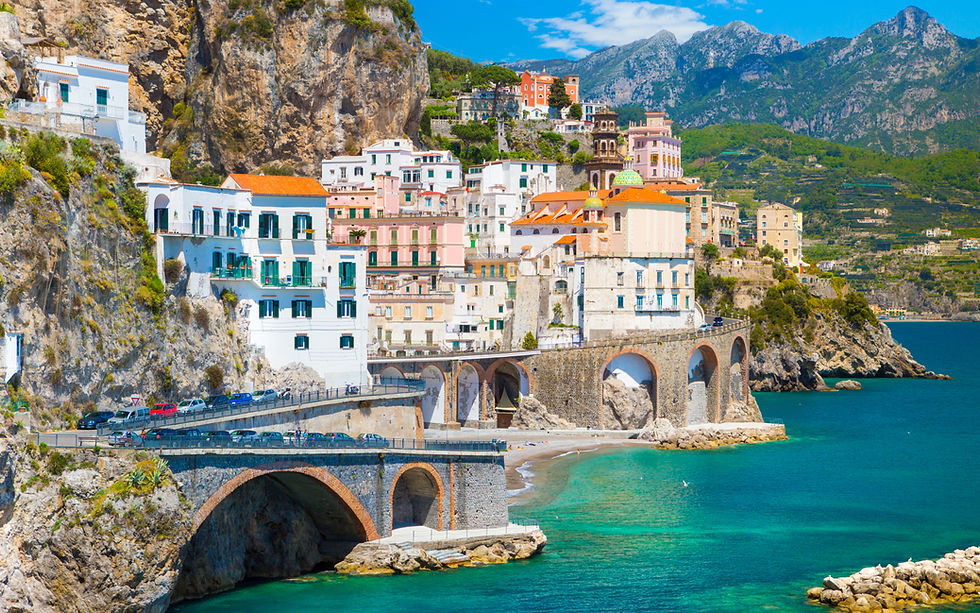
The Amalfi Coast remains one of the most desired coastal destinations in Italy, and rightly so. Ravello, Amalfi, Minori, Maiori, Vietri sul Mare, and Positano continue to draw travelers for their views, architecture, and sea-facing drama. Official Italian tourism materials point to Ravello as one of the 16 municipalities of the Amalfi Coast, all within the province of Salerno, and describe the Salerno coast as dotted with unmissable villages.
Yet staying directly in the Amalfi Coast is not always the best choice for every traveler. It can mean heavier crowds, more hotel-switch pressure, more limited flexibility, and a stay that becomes more about navigating demand than enjoying the place.
Salerno creates a more intelligent alternative. It allows travelers to experience the Amalfi Coast as part of a broader journey rather than as the entire framework of the trip. That creates space for balance. A day on the coast can be followed by an evening in a more grounded city. A scenic route can be paired with local food culture, archaeology, or quiet inland discoveries. The result is not less beauty. It is more dimension.

From Salerno, history becomes a living part of the itinerary
Campania is one of Europe’s richest regions for layered history, and Salerno is exceptionally well placed for travelers who want to engage with that history beyond surface-level sightseeing.
Pompeii is perhaps the most internationally recognized example. UNESCO describes it as a uniquely preserved Roman city that offers a complete picture of ancient urban life, including forums, temples, baths, theaters, and public spaces. Paestum, meanwhile, belongs to the UNESCO-listed cultural landscape of Cilento and Vallo di Diano National Park, with its archaeological sites recognized as part of a major World Heritage property.
What makes Salerno powerful is that these are not isolated bucket-list stops from here. They can become chapters in a more coherent itinerary. One day may lead into Greek temples and open landscapes. Another may reveal the material life of ancient Rome. Another may turn toward gardens, cathedrals, or contemporary interpretations of the city itself. Instead of feeling like disconnected excursions, the region starts to read as a cultural whole.
For a more thoughtful traveler, this is the difference between seeing Campania and understanding it.
Salerno opens the door to the Campania many travelers miss
One of the strongest reasons to choose Salerno is that it invites travelers beyond the obvious. The region is not only about iconic coastal views. It is also about pastoral landscapes, archaeological depth, food traditions, family-run production, and the slower emotional register of Southern Italy.
Official tourism content on Cilento presents it as a journey through varied stops including Paestum, Agropoli, Castellabate, the national park, and inland points of discovery. That broader geography matters because many travelers now want more than a sequence of famous places. They want access to what still feels rooted. They want places where the experience is shaped by encounter, not only by volume.
Salerno makes those itineraries possible. It is a natural anchor for journeys that combine coastline and countryside, private cultural experiences and slow mornings, landmark sites and hidden corners. It helps create the kind of trip that feels designed rather than assembled.

The city aligns with a slower, more personal style of travel
The future of luxury travel is not only about excess. Increasingly, it is about access, relevance, and emotional fit. Travelers want beauty, but they also want coherence. They want fewer generic experiences and more carefully chosen ones. They want to feel that a trip reflects who they are, not simply what is trending.
That is exactly why Salerno works so well for a bespoke travel concept.
Your own site already frames this beautifully: a stay in Salerno paired with curated journeys across Campania, beginning with the city as a base and building outward through coast, culture, countryside, and meaningful local experiences. This is strong positioning because it replaces the old “hotel plus activities” model with something more editorial and more intelligent. The city becomes the anchor. The journey becomes the product.
In practical terms, that means a guest can shape the trip around rhythm and interest. Art and archaeology. Food and wine. Family memory-making. Quiet romantic escapes. Craft, landscapes, local experts, and hidden places. Salerno is flexible enough to support all of those directions without losing its own identity.
Why this matters for travelers choosing where to stay in Campania
Many travelers search for broad terms like best base in Campania, where to stay near the Amalfi Coast, Salerno or Amalfi, or best place to stay for Pompeii and Paestum. What they are really asking is this: where can I stay that gives me beauty, convenience, and depth all at once?
Salerno is one of the best answers.
It gives travelers access to iconic destinations without trapping them inside overtourism. It offers a real city experience with elegance and authenticity. It connects naturally to the Amalfi Coast, Pompeii, and Paestum, while also opening the way to Cilento and less expected parts of the region. And perhaps most importantly, it supports a more meaningful style of travel: one based on intention, not just movement.
For travelers who want Campania to feel personal, layered, and memorable, Salerno is not the compromise. It is the strategy.

A more meaningful journey begins with the right base
The best journeys are rarely the ones that try to do everything. They are the ones that begin in the right place and unfold with purpose.
Salerno offers that beginning.
It is cultured but accessible. Connected but still grounded. Beautiful without being performative. From here, Campania opens in multiple directions: toward sea, heritage, villages, gardens, archaeology, food, and the quieter forms of wonder that make Southern Italy unforgettable.
For us, that is the real promise of staying in Salerno. Not simply that you can see more, but that you can experience the region better.
And when travel is designed with that kind of intention, the journey becomes more than a trip. It becomes a way of arriving more deeply into a place.


Comments